
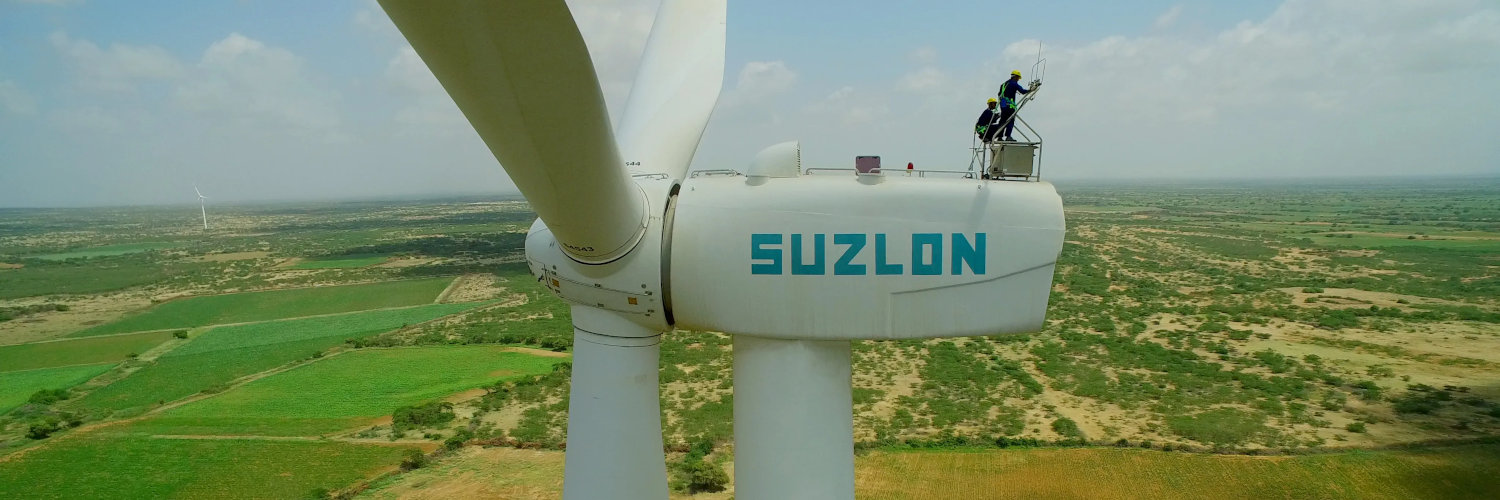

Suzlon Energy Ltd
NSE:SUZLON



Decide at what price you'd be comfortable buying and we'll help you stay ready.

|
Johnson & Johnson
NYSE:JNJ
|
US |

|
Berkshire Hathaway Inc
NYSE:BRK.A
|
US |

|
Bank of America Corp
NYSE:BAC
|
US |

|
Mastercard Inc
NYSE:MA
|
US |

|
UnitedHealth Group Inc
NYSE:UNH
|
US |

|
Exxon Mobil Corp
NYSE:XOM
|
US |

|
Pfizer Inc
NYSE:PFE
|
US |

|
Nike Inc
NYSE:NKE
|
US |

|
Visa Inc
NYSE:V
|
US |

|
Alibaba Group Holding Ltd
NYSE:BABA
|
CN |

|
JPMorgan Chase & Co
NYSE:JPM
|
US |

|
Coca-Cola Co
NYSE:KO
|
US |

|
Verizon Communications Inc
NYSE:VZ
|
US |

|
Chevron Corp
NYSE:CVX
|
US |

|
Walt Disney Co
NYSE:DIS
|
US |

|
PayPal Holdings Inc
NASDAQ:PYPL
|
US |
Q3-2026 Earnings Call
AI Summary
Earnings Call on Feb 5, 2026
Record Deliveries: Suzlon delivered 670 MW in Q3 FY '26, the highest ever for any quarter in India since the company's inception.
Strong Financial Performance: Q3 revenue reached INR 4,228 crore with EBITDA of INR 739 crore, up 48% year-on-year, and PAT of INR 445 crore.
Robust Order Book: Order book stands at a record 6.4 GW, with a book-to-bill ratio of 1.9x; over 3 GW of new orders were won in the financial year.
Guidance Maintained: Management reaffirmed its FY '26 guidance for 60% year-on-year growth across key metrics and expressed confidence in execution.
Export & EPC Expansion: Suzlon is targeting export-driven growth, has appointed a President for Europe, and increased its EPC share from 20% to 27% in Q3.
Execution Challenges: Project execution remains a sector-wide challenge, mainly due to land acquisition and right-of-way issues, but measures are underway to improve.
Balance Sheet Strength: Suzlon reported a strong net worth of INR 8,332 crore and a net cash position of INR 1,556 crore as of December 2025.
Suzlon reported a record order book of 6.4 GW, with significant new order wins exceeding 3 GW so far this financial year. The book-to-bill ratio stands at 1.9x, and the company sees continued strong demand, particularly from the C&I segment (51% of the order book). Management emphasized that order intake is not a constraint for growth, with a steady pipeline of 3-4 GW in discussions.
Q3 FY '26 was a record quarter for Suzlon, with revenue of INR 4,228 crore and EBITDA of INR 739 crore, reflecting a 48% year-on-year increase. Nine-month figures also showed strong growth in deliveries (66% up year-on-year), revenue (58% up), EBITDA (77% up), and PAT. The company maintained a robust net worth and net cash position, underscoring its financial health.
Management reaffirmed its FY '26 guidance of 60% year-on-year growth across key metrics. There is no downward revision expected, and the team remains confident of meeting targets despite execution headwinds. The guidance includes delivering 2.5 GW for the year, with 1.6 GW already achieved in the first nine months.
Execution remains a challenge due to land acquisition, right-of-way, and grid connectivity issues. Management acknowledged project delays and slow offtake, noting that these obstacles are sector-wide. A government task force has recently been established to address these bottlenecks, but resolutions may take time. Suzlon aims to improve execution through a more focused development approach and by increasing its share of EPC projects.
Suzlon is expanding its EPC offering, which has grown from 20% to 27% in Q3. The company plans to launch a separate development vertical (DevCo) for project development, aiming for better long-term site planning and faster execution. Management stressed that this strategy requires only seed capital and will not entail significant balance sheet risk.
With trade agreements in place and a new European President appointed, Suzlon is positioning itself to tap export opportunities. While the US market remains uncertain, the company is focusing on Europe, Australia, South Africa, and the Middle East. Initial export order traction is expected in the next financial year, with revenue contributions beginning in FY '28.
Suzlon continues to ramp up its manufacturing base, including establishing three new AI-enabled smart blade factories. The company is progressing towards a 5 MW platform, currently in the prototype phase, but also sees continued strong uptake for its 3.15 MW and newly launched 3.3 MW models. AI is also being integrated into the OMS business for predictive and preventive maintenance.
The forging and foundry segment delivered 33% year-on-year revenue growth over nine months, with rising capacity utilization and margins. Non-wind business is expected to contribute more in FY '27. The US trade deal is anticipated to boost exports, particularly to GE, which should further support growth in this segment.

Ladies and gentlemen, good day, and welcome to the Suzlon Energy Limited Q3 FY '26 Earnings Conference Call. During this call, the company management may make certain statements that reflect the outlook of the future, which could be construed as forward-looking statements. These statements are based on management's current expectations and are associated with uncertainties and risks as detailed in the annual report. Actual results may differ so this statement should be reviewed in conjunction with the risks the company faces.
[Operator Instructions] Please note that this conference is being recorded. So will begin with the opening remarks followed by a Q&A session. To be fair to others, we kindly request each participant to ask no more than 2 or 3 questions.
From the management, we have with us Mr. J.P. Chalasani, Group CEO; Mr. Rahul Jain, Group CFO; and senior members of our finance team. I now hand over the conference to Mr. J.P. Chalasani, sir. Thank you, and over to you, sir.
Thank you so much. Good afternoon, everyone, and thank you for joining us for Suzlon Quarter 3 FY '26 Earnings Conference Call. For the first time I'm joined by Rahul Jain, our CFO, for some of you met and more of you meeting him. Unfortunately, my throat is in pretty bad condition, continuously coughing since morning. What I -- I want to preserve my energy for Q&A. So I would ask -- I would request Rahul to take you through our opening comments. But I'm here for subsequent Q&A. Sorry for about that.
Thank you, J.P. Chalasani, sir. Good afternoon, ladies and gentlemen. Many of you may know me from previous and earlier associations. But for the benefit of the larger group, please allow me to introduce myself. I am Rahul Jain, and I recently joined Suzlon Energy Limited as Group CFO. It is truly my privilege to be a part of this forum today. Prior to Suzlon, I have been associated with SRF Limited and Jubilant Organosys Limited.
I'll now take you through talking about the industry, certain business highlights and continue on the financial piece as well.
We recently celebrated an important milestone, 30 years of Suzlon's journey and [ TRT's ] birthday on 2nd February. It reinforces the vision, resilience and forward-looking spirits that Tulsi bhai Instilled in Suzlon, values that continue to guide best and inspire us even today.
Talking about the industry. India's wind sector is witnessing its strongest growth sales. The year 2025 has been a landmark with [ wind ] installations touching a record 6.34 gigawatt surpassing the previous peak and clearly reaffirming the vast demand potential of wind energy in the country. Industry is well positioned to move to higher installation year after year with a clear trajectory to sub 10 gigawatts over the next 2 years.
With 54 gigawatt already installed and a strong pipeline with STU and PSU bids as well as C&I demand, India is set to achieve the near-term target of 100 gigawatts by 2030.
Repowering also started gaining traction, and there is rising customer interest with the visibility of several opportunities ramping up in the next 1 to 2 years. The market opportunity for Indian wind industry is even larger as it is gearing up to become a global sourcing hub for wind turbines and components. With adequate and low-cost domestic manufacturing capacity, India is emerging as a credible supplier for nearly 10% of global wind demand.
Suzlon is also focusing for strong export-driven volume growth powered by competitive Make in India manufacturing base as our long-standing global operating experience. To accelerate this, we have strengthened our global leadership with the appointment of Paulo Soares as President, Europe. Ensuring deeper engagement and faster market scaling across key geographies. With the EU trade agreement already in place and a U.S. trade deal getting finalized, Suzlon is well positioned to tap significant export opportunities, both for WTG components and for SE Forge castings.
Coming to business highlights. We are pleased to report yet another record-breaking quarter as Suzlon has set a new benchmark in execution by delivering a record breaking 670 megawatts in Q3 FY '26. I the highest-ever quarterly deliveries in India since inception.
Yet again, highest ever order book of 6.4 gigawatts, reaffirming our market leadership powered by over 3 gigawatt new order wins in this financial year itself, resulting in a book-to-bill ratio of 1.9x. The focus now is on expanding our EPC offering, which has grown from 20% to 27% in Q3, which enhances our competitive edge and further help to accelerate order book growth. The S144 order book has exceeded 5.4 gigawatts, a strong endorsement of its advanced technology and customer trust.
On the manufacturing front, our 4.5 gigawatt manufacturing capacity is fully operational and scaled to support the current order book. We are also establishing 3 new AI-enabled smart blade factories further expanding our footprint.
Suzlon commissioned 442 megawatts in 9 months. And further to that, another 2,354 megawatt is in active execution in various stages. Further, we are also working to develop a strong development pipeline of 25-plus gigawatt. We have included these details as a part of our investor presentation.
Finally, refer to Slide 23. Our OMS business remained strong with 15.5 gigawatt plus under management in India and machine availability consistently above 95%. Renom's AUM is consistently growing on the back of steady fleet additions and healthy pipeline. Our Forging and Foundry business is unlocking its potential, delivering 33% Y-o-Y revenue growth in 9 months to INR 429 crores, with EBITDA INR 288 crores. We expect this growth momentum to continue with stronger domestic demand and export opportunities.
Suzlon has been ranked among the top 10 most sustainable companies globally. For 2026, by Global 100 Most Sustainable Corporation list by Corporate Knights. We are deeply honored by this recognition, especially as Suzlon is the only Indian company featured in the list.
With strong performance in the first 9 months, we are firmly on track to achieve our FY '26 guidance of 60% Y-o-Y growth across key KPIs. I would be using Slides 18 to 27 of our investor presentation, which has been uploaded on our website as the reference point for my discussion during the presentation. In Q3 FY '26, Suzlon continues its exponential growth trajectory, delivering 670-megawatt highest ever India deliveries for any quarter with all financial parameters showing strong uptrend. Suzlon reported a revenue of INR 4,228 crores in Q3 FY '26 with an EBITDA reaching INR 739 crores, a robust 48% year-on-year growth with PBT of INR 567 crores and a PAT of INR 445 crores.
In 9 months FY '26, deliveries grew 66% to 1,625 megawatts surpassing the full year FY '25 level of 1,550 megawatts in FY '25. Strong execution momentum drove revenues to INR 11,211 crores, up 58% Y-o-Y. Consolidated EBITDA increased to INR 2,058 crores reflecting a strong turnaround with 77% Y-o-Y growth. PBT rose 77% to INR 1,589 crores with reported PAT improving to INR 2,049 crores. We are pleased to report that our balance sheet as of December 25 reflects a position of exceptional strength. Strong consolidated net worth of INR 8,332 crores. Our net cash position is at INR 1,556 crores further enhancing our financial flexibility and resilience.
Adequate working capital limits tied up for execution of the current order book. Our end-to-end wind energy model supported by an integrated supply chain, strong execution and industry-leading service provides a competitive edge that is unique and difficult for others to match. Thank you.
And I now request the operator to open the line for Q&A.
Thank you very much, sir. [Operator Instructions] The first question is from the line of Sumit Kishore from Axis Capital.
Good evening, J.P.C. sir, and welcome Mr. Rahul Jain. My first question is out of the 2,354 megawatt execution pipeline, how many megawatts [ aging-wise ] are pre FY '25. Similarly, in your trade receivables of INR 5,745 crores, how much receivable is due beyond 1 year. So on both counts, can you -- about the risk of further delays for both your customer and for Suzlon? That's my first question.
See, effectively, if you take out the quarter 3 supplies, I hope I'm audible. So if you take out quarter 3 supplies of 617 megawatts. The balance is what we're talking about to [ 354, ] which is what is on execution. The current supplies happened in Q3 are the ones which are not in the different stage of execution, predominantly there could be 50 megawatts from this is done, 50-megawatt of, let's say, Q2 is there. But the otherwise directionally, that is what is -- you can take it, okay? Out of 3,000 megawatts, what is the supply the uncommissioned 2,919, whatever it is, they should take out Q3, that's the balance. The second one is on receivables.
No. Sir, the first question was also that how much of this 2,354 megawatts has been sitting under execution? Even pre-FY '25, how much is sitting in 2,354, which has been under execution for the last 7-plus quarters.
There would be -- let me pull that number. I don't have it right away that [ 325, ] I think would be somewhere around 50 to 60 megawatts.
Talking about pre-FY '25, so that is what it is that -- be predominantly 1 project in Karnataka, which is stuck because of land and legacy. Otherwise, there's nothing beyond that.
On receivables?
Okay. So to answer on the receivables, right, our total receivables are roughly about INR 5,700 crores. Those that are not due in terms of saying that certain milestones are still to be completed are roughly about INR 2100 crores. Therefore, the balance number is INR 2,600 crores -- 3,600 -- so that's the number.
INR 2,600 crores less than 1 year?
Yes, largely, I would say.
There are no big overdue receivables, I would say. Some obviously are there, but not big ones.
Got it. The second question is on WTG EBITDA margin in Q3, which is 13.7% versus 15.6% in H1 and 16% in Q2. So why is the dip in Q3 happening? Is it going to higher EPC in the mix? Or are there other reasons as well?
Come again, Sumit, sorry?
Sir, the WTG EBITDA margin in Q3 is 13.7% versus 15.6% in the first half of the fiscal. Why is the dip in Q3? Is it higher EPC in the mix of the...
What happens is that it depends upon a couple of things. One is the average sales price during the quarter depending upon who is the customer is supplying. So the impact of one large customer not being there this quarter impact is almost about 1.9%. And then the another is roughly because the project revenues have gone up, project margin is being lower than the supply margin. So therefore, you see [ this. ] These 2 are basically causing 300 basis points.
So basically, EPC share is higher than product delivery, when you say project margin.
No, no, not EPC share. I'm saying average sales price of turbine has come down in this quarter because it depends upon whom are we supplying because contract to contract realization changes, okay? In the previous 2 quarters, we had a customer where the realization was very high. The impact of change in the mix of customers because we'll keep changing quarter-to-quarter, change in the mix of customers to whom we supplied and the average sales price coming down, impact of that is almost close to 200 basis points, 190 basis points, not [indiscernible].
Second is the project revenue, that is where you can say EPC or SIA, only EPC SIA, projects revenue has gone up this quarter. So projects revenue margin being very low compared to supply margins. The proportion of project revenue keeps increasing, your margins fall. Like, for example, we always keep saying the overall group level and WTG revenues goes up and OMS being the higher margin, but that proportion comes down, our overall margins also come down. Similar way, here, the average sales price and the project revenue is what will decide quarter-to-quarter for the margin. But if you see our 9 months level, we are still healthy.
Yes, got it. My last question, sir, on the key -- in the press release for Suzlon 2.0, you mentioned that your plan includes launching DevCo as a stand-alone FDRE project development vertical. What is the implication on balance sheet commitment for Suzlon? And what does it mean for ROCE and leverage levels for Suzlon targeted going forward?
No, this is nothing but what we have been talking from, I think, last few quarters of our taking the development route to increase our EPC share.
Okay. It does not mean committing balance sheet. Okay.
We said that we need some seed capital and start doing it. What this development company because we wanted a more focused approach, not getting concerned with the day-to-day project execution and the land concerns in the projects. This business, call it a separate company subsidiary, but this business unit would concentrate on 2 things. So because the first thing it identifies which are the potential sites over the next 5 years based on the green data what we have, okay? Then therefore, it identifies what are the sites for year 3, 4 and 5 from now.
And we start acting on that. And that is where we will have more strategic sales with the large customers for work in the renewable energy business to do on a long-term basis. Mostly if you want to do year 3, 4 and 5, so let's now tie up for 3, 4, 5 for the purpose of land and everything. And by the time we start in year 3, most of the land is acquired, your connectivity is there, everything is there. So when you start your work, your IDC is the shortest. Plus you have a clear visibility of year 3, 4, 5 targets, okay. That's one segment what development company does. So we will start having that strategic sales for year 3, 4, 5.
Second one, what it does is what I explained earlier that we start acquiring the land and before we reach 25% we get a client and they take over the 25% and start paying us for the land thereafter, but EPC NTP will come a little later and let's say, 50%, 60%, 70%, what is the comfort of both levels, both of us to do so that their IDC would come down substantially and the project gets executed much faster. And once it enters into a project phase, let's say, there is 25%, 30% of the land still to be acquired. That's the only portion the projects division will take over because project activities have already started, EPC activity started.
And the team which is working on the land from the development on the ground team will get subsumed into that projects division. Basically, this is an advanced action. And what it does is after identifying sites, we need to get local authorities approvals, whether it is [indiscernible] or wherever it is, it can get those approvals start acquiring if it's an SKU, we'll also start getting connectivity, will also plan in future what is to be on the CTU depending upon how the business unfolds in CTU.
So keep everything ready so that the execution is faster, and we will get more and more EPC contracts. It's good for us and good for the clients. It does business in a very, very focused way. There is no significant change in business model, but we are creating a business unit, which is more focused only in that. And here, it is not to do with any balance sheet putting, we just put the seed capital.
The next question is from the line of Deepesh Agarwal from UTI AMC.
Sir, my first question is over the past 1 year, renewable tenders have been quite weak in the country. How confident are you of growing your order book, especially when the execution pace goes up from here?
Let me start with our order book mix, Deepesh. First one is that the current order book when you look at 51% is from C&I and Captive segment, okay? No involvement in the bidding, 36% is from bidding.
Deepesh, if you could put yourself on mute, I think there is background noise, so we could control that.
And about 13% is from PSU segment. So our involvement in the bidding is to the extent of 36%. That also has gone up, I explained in the last quarter because we had a huge order from Tata Power. While what you say in terms of bidding activity at the central level has taken a pause, I don't say it stopped, taken a pause because we want to resolve that issues of outstanding PPAs and various things. State level bidding is now picking up, okay? We're seeing in [ GUNL ] bid has come in, NPA has come in, now other states are talking about it. That will keep going up.
Even in the central level, if you see that the -- I'm sure that all of you have followed, yesterday was the SECI 19 or something, the reverse auction happened. And till date, most of the bids for SECI were undersubscribed. This is a pure wind bid for 1,000 megawatts. It was oversubscribed by 3x, okay? So there were offers for 3,000 megawatts and the tariff is 2.67 to 2.69 depending upon those are the people who won, okay, after that. So therefore, for the wind, wherever there is a stand-alone wind bid, there is still -- there is a significant amount of demand happening.
While I see that there is a pause, but I think the -- with what was going to happen in terms of state bidding and more importantly, with the significant amount of data centers now planned to be commissioned by 2030. All these data centers are supposed to be the green data centers. That's going to push significant growth in renewable energy. And our -- the strength is in that area, which comes under C&I. So I will accept your point, but I don't see that it's going to have a significant impact for our business.
Sure. Can you also add some color on exports now given EUFC has been signed, U.S. trade deal has happened. I think you have also appointed someone as Head of your European business. So some more color on how is our export pipeline shaping up?
On the U.S., Deepesh, I actually -- everyday morning, I check whether they have a potential or not because it depends upon what comes on the true threshold, the wind will happen or wind will not happen. You know and I know. So it is nothing to do with the trade deal because right now, from the current government point of view, wind is not favored and they don't want to do wind. While that is a significant potential for us because we -- that was our largest market in the previous time, but we'll continue to wait and watch when that market opens up.
That's why we moved our focus to Europe. That's where you have seen Paulo's announcement. In fact, he was with us earlier when he stopped international business went out, but came back to us. We are exploring Europe. We are exploring Australia, South Africa, Middle East and Portugal, few other countries. As I said earlier, you will see some traction in terms of orders getting announced in the next financial year. But the supply starting and the revenue flowing in will be in FY '28. And the U.S., we need to wait and watch when that gets opened up.
Sure. And lastly, sir, I think some of our Chinese peers have introduced 5-megawatt platform, and it seems that selling PG basically, it is 8% to 10% cheaper in LCOE over 3-megawatt platform. I want to understand how far is Suzlon from launching that 5-megawatt platform?
Let me define how far is actually a very subjective question, Deepesh. If you ask me, we are very near, okay? But that very near could be a little far for you. But anyway, but what I want to assure you is that our 5 megawatt turbine is now getting into the photo stage, and that will come at time. But the thing let me tell you is that the -- in spite of the fact there is a 5-megawatt turbine launched, our 3.15 megawatt is growing significantly. And now we have also introduced -- started selling 3.3 megawatts with the revised power, which has a lower cost per kilowatt hour compared to 3.15.
And my feedback, I'm sure that some of you would have the feedback, a 5 megawatt when they started actually implementing because original feeling was that you need less number of footprint is actually land acquisition is becoming a big headache because a 5 megawatt footprint actually needs multiple farmers to sign because you need a larger land area compared to a 3 megawatt. So making each farmer to agree for 1 footprint because they have multiple farmers is creating an issue.
In fact, I was talking to a few of the developers, I think they're actually saying that is it the right strategy for us to go because we sell into it because you need less number of footprints. Less number of footprints doesn't mean that it's a faster execution. Even that is happening. But still, we are coming with 5 megawatts. So therefore, I'm not against 5 megawatts, okay? So the -- our 5 megawatts will come at the appropriate time. And we would ensure that turbine delay will not impact our intake of orders.
The next question is from the line of Shiva from Purnartha Investment Advisors.
So my first question is with respect to forging. Obviously, the last time when we said we are planning to increase the revenue. But the 9 months others, that is the revenue that we get from the other, not Suzlon, that hasn't improved much. It's more or less flat. So could you just throw what was the issue over there? And going ahead, how do you look at it?
Yes. The SE Forge, as we said in our opening comments, is the one which is now unfolding its potential. As we said that the overall between Foundry and Forging, the capacity utilization has gone up from 21% to 31%, 31% is small, but fine, but relatively, we improved by 10 percentage points in the last 1 quarter. And the profitability has improved. EBITDA has gone up from -- doubled from INR 40 crores, and our margins have gone up from 12% to 20%.
On your specific question of non-wind and other things, work has started in terms of non-wind like your injection mold machines and various other things. But what happens in case of castings is it takes before other starts getting implemented, the process of preparing a casting prototype and getting it approved is a long run process. They're going through that process. You would really see in FY '27, the revenues coming from non-wind substantially going up compared to what it is now. So that's clearly we're on the path of increasing non-wind.
And the second is that because of the U.S. trade deal, till now whatever the tariff was there, so we had an impact on U.S. exports. We export big way to U.S., especially to GE. But now with the -- whatever the trade deal announced, and that will again come back. The GE is again will be back in that. So both ways, the wind also will increase and the non-wind will increase. And we are -- I'm especially personally quite excited on SE Forge as we move forward. A number of things we are doing there especially in the forging.
The second is with respect to installations. Just they were slightly slow, but if you take a 7 quarter data also and ratio of deliveries to installations, we're at 36% odd. So whatever we've delivered, roughly 2 gigawatts more has to be installed. So -- and I just wanted to understand what are the main pain points or which are the regions where we're struggling or in this specific 3 gigawatts that have already been installed are delivered? And compared to other players, how are we placed in those regions?
Definitely, Shiva, I'm not going to say that we are great doing an execution. Execution obviously remains a challenge for us as a sector. In fact, maybe for us more because of the numbers because others numbers, we don't know fully. We only know the total numbers, okay? The segment-wise, we don't know. And how old it is also, we don't know. So therefore, I'm not really concerned about what others are doing and why we can't do it. I know that we are only at 10% market share as of today. We gave a guidance we'll reach at least 25% by end of this year, taking 6 gigawatts at the top, and we are still working towards that.
The reason why the execution is getting delayed is the -- first of all, this is -- until now it is 80-20, 20 is EPC and 80 is non-EPC. So we have a limited control on land and BOP in those projects. So that's one reason. Even it doesn't mean that we are doing EPC, everything is [indiscernible] I don't want to claim that. Even we are having issues with respect to execution, but slightly better compared to them. The challenges are the same, your ROW and first of all, land coming in time because the acquiring each land, negotiating with farmers becoming a major, major issue.
And then thereafter, ROW issues keep cropping up every single day. And the ROW not just for the turbine, including for your [indiscernible] system. And then you were the main evacuation system to be done. For example, this quarter, we have 253 megawatts of turbines pre-commissioned, which they can generate today, provided they get connected to the grid, okay? So some places, grid is not there, which is the client is supposed to provide some places. They said system of the client is not there. So therefore, these are the delays.
In fact, there is 80 megawatts sitting out there could have been easily commissioned, but for the issue of temperature, okay, which confusion between MNRE and MOP, which they are trying to resolve. So while there are -- there is definitely a need and scope for us to improve on execution. There is no second doubt about it. But there are the issues which we know what are the issues. That's the reason we gave that breakup of how much is under implementation. We are reasonably confident that by end of this year, especially in the quarter 4, you will see a significant jump in terms of our execution, and it will pick up.
And once we start getting into more and more EPC through development, this will change. Question is whether somebody else is able to do better than us, I'm not too sure. I will not be able to comment. But one can obviously ask that you're only 10% is somebody else has done 90%. That's a legitimate question to say that there are people who have done 90%, but that [ aging ] and those things, I really don't know. I'm only looking at myself, not looking at the market. There is a significant scope for us to improve this, and we are working at it, and we will improve it. There is no second opinion about it. We got to do it and we will do it.
Okay. Helpful. And the last one is with respect to battery storage. Obviously, it is not a source of generation. But if the battery costs go down and the quantity of batteries goes up, the plant load factor of solar and wind will go up indirectly, right? So the amount of gigawatts that in the long-term, just trying to understand in a very long-term, might not be that much -- it decreases the amount of gigawatts that need to be set up, right? So is it not highly dependent on the cost of batteries?
No. Battery doesn't add any generation. Battery only...
I'm saying the plant load factors will increase, right, because it will store energy. So the 1 gigawatt which...
Yes, but you ask to store energy, it has to be produced. So whatever is the solar or wind connected to the battery, that still generate. So if you need, let's say, 1 billion units, you still need billion units to be generated. What battery does is actually it tries to match your load curve and the generation curve. That's all it does, okay? It has no impact on your PLF.
I'm saying if earlier, 1 gigawatt of wind used to produce like x amount. Now because of the battery, 1 gigawatt of wind and 1 gigawatt of solar used to give x amount. Now when we put in battery because the unused hours, you can store that and you can indirectly increase the energy, the electricity consumed at the night. So you don't need that much amount of gigawatts to set up, right, if the battery becomes efficient.
A little more complex. Your point is answer is, yes and no. If you are -- if you have a generation curve, let's say, I mean the load demand curve, you have a peak demand, fine. You are creating your generating capacity to meet peak demand and which remains not utilized during the off-peak period, rest of the period, PLF will be low, definitely low, okay, because we are not utilizing it. So therefore, the moment you put the battery, the amount of generating capacity, what is to be put to meet the same load curve will come down. You're fine from that point of view, okay? So it will come down.
So therefore, that's the reason I said that this only matches between the demand curve and the load curve. But today, people -- that is not what people are doing. People are -- that is how we went ahead in solar. So what's happening now is solar getting -- the backing down is happening in solar. So directionally, your point is valid. It means like theoretically, yes, you're right. So if you're setting up a capacity to meet peak demand, now if you put the battery, the capacity of what is to be created to solar or wind would come down because you're trying to flatten the generation curve to match the load curve. That I agree with you. Then what it does is, the cost per kilowatt hour would come down. So then obviously...
So if the batteries become very cheap in like 10 years, then this projections might get a hit, right? I mean we don't know what happens, but it is highly dependent on how efficient the batteries are and what is the manufacturing cost of the battery.
In battery, we really don't know anything today. We're talking about...
Yes, yes, as of now.
And then single source, okay? Single source today. And one single source can actually turn the key and then actually close up. So therefore, what happens to the battery, what is going to happen, you're seeing what is happening in the module suddenly, you see the prices going up, prices coming down. So I think the -- what is important for the country as a whole, storage is mandatory. There is no secondary opinion about it. One thing is clear in renewable energy consumption, storage is mandatory. Otherwise, only alternative is more and more fossil fuel.
Whether it is a battery or the PHP and how it happens is what we need to wait and see, but storage is mandatory. Without storage, renewable energy will not grow. Here also we said clearly, the stand-alone solar will not grow unless solar and wind is there. This is our stated stand for the 5 years when people ridiculed us. But today, I'm again saying that without storage, the renewable energy will not grow. And at the same time, answer to your question is that for a given demand, the capacity required for wind and solar will come down. But the moment you put storage, you're flattening the generation curve or matching generation with demand curve, overall demand for renewable energy will go up. Did you get my point?
Yes.
The next question is from the line of Mahesh Patil from ICICI Securities.
First of all, congrats on a good set of results. Sir, my question is since we have completed 9 months and regarding our guidance, right, 60% growth across all parameters and around 2.5 gigawatt of deliveries. So 1.6 gigawatt we have already done. I'm not expecting any numbers, but directionally, how do you see -- is there any change in guidance? Or how do you see Q4 panning out [indiscernible]
I said 100%, we are committed to 60%. We will achieve that. If there was any downward revision, we would have come forward on our own to say that. But there is no downward revision pretty confident to get to that 60% growth. There is absolutely no doubt about it.
You might back calculate, you might say this is till now you are not done yet [Foreign Language] capacity dispatch [Foreign Language] maybe a year back, if I told you that we'll dispatch 600 megawatts in 1 year, you [indiscernible] okay. So therefore, I can only say at this point of time, not commenting on [indiscernible] I can reassure you all that 16% guidance what we gave is completely online, and we will achieve that.
The next question is from the line of Sudhanshu from JM Financial.
So I have 2 queries. One is, can you please share the order pipeline, if possible? And second, why our working capital requirement is increasing?
Sudhanshu, that I always treat you as a professor. I look forward to your statements every weekend. Sunday comes, Sunday evening, I look at where is Sudhanshu's [indiscernible]. So you're asking me a question. I treat you as a professor. Anyway, let me answer your question. The order pipeline is strong. As we speak today, we are now clearly talking about 3 to 4 gigawatts non-bidding route of discussions are happening. So -- and C&I, we don't know how it keeps opening up.
I still maintain -- while people might say that your order intake is only 800 megawatts last meeting to this meeting and things like that, I still maintain the statement which I've been making, Sudhanshu, every single quarter. Order is not an issue for us. The issue is execution. If we improve the execution as a sector, we can supply more. We did 617 last quarter. It pains me to stop at 617. We could have easily done 750 megawatts, easily without any problem, but then your projects have got ready to offtake, okay? That's the issue. Issue is not that how much can we supply in a quarter.
We can actually supply 1,100 megawatts in a quarter if there is a consistent offtake from the projects. Problem is execution is killing us, ours as well as others because you know that our is 20%, 80% is controlled by someone else. And you know it better than anyone else in the sector, okay? That's the problem. On the working capital, you're spot on. So obviously, that the -- I explained earlier that one of the contract which we built in the provisions to the large contract because of the delayed payments and everything, we have taken separate line of credit for that particular contract.
But still the payments there, the processes have taken much longer time than what it is. And that's what made us to get stuck. And working capital requirements today, Sudhanshu, as long as we keep doing these public sector for these projects would continue to be at kind of level. It may not significantly increase, but will remain at these levels, okay? Unless we start seeing the results of our development company, which is what I said that will start maybe giving us results from the, let's say, end of next year, second half of next year to FY '28.
For example, like we're taking the latest contract [indiscernible]. That's typical of what we have been talking. So there, we have the land contract much in advance. By the time we signed this contract, we already have 50% of the land. But still, we are not taking the NTP for EPC. So we said that let's acquire more land, get all the pathways everything. Then we will take an NTP. And we can do a quick execution, good for them, good for us. Their IDC comes down, our working capital comes down. I think we got to move to that stage. We are moving it consciously in that direction, but it will take some more time. We need some patience to move there. Is it fine, Sudhanshu?
The next question is from the line of [ Harish Singh from Shubhlabh ] Research Private Limited.
Mr. Chalasani, I just wanted some granular details on this slow offtake, which you have been mentioning in this call so far because for the past 4, 5 quarters, probably this issue has come for the first time in our conference call. So far, the deliveries were good and we were executing well. But probably this quarter, the deliveries has gone down. And this slow offtake issue has come up. So if you can help us understand a bit more about...
Just be clear about it, it is not the first time. Each of those quarters compared to what we supplied, we could have supplied at least 15% to 20% more each of the quarters, whether it's quarter 1, quarter 2 or quarter 3, okay? And it is not our supplies have come down. Maybe it has come down with respect to the expectations what people had building up to 2.5 gigawatts. But otherwise, this is -- as we said in our opening comments, this is the highest delivery we ever did in a single quarter. But the expectation was different, okay? Because everybody is doing mathematic calculation of saying that 60% [Foreign Language] 700 megawatts [Foreign Language] this quarter [Foreign Language].
So when it is 617, some people felt that they have not met the expectations. That's the issue, not that when we're dealing with respect to 60% NC, obviously, the growth is big, okay? So I don't think that's an issue. The issue of offtake, which we have been saying is there every single quarter. Even last year, we had 3 gigawatts of manufacturing capacity we supplied 1,550. Now we have 4.5 gigawatt capacity, and we're talking about 2.5 gigawatts of supply. But why? So therefore, offtake, not just for us, every single OEM has offtake issue in India, every single OEM, right?
So as all the OEMs put together, supply can be much more than what today the absorption is happening on the project side. So it is nothing new. So because this quarter, it is less than what you've been expecting, while we are seeing that we have done the highest, but still the highest is not beating your expectations, you're saying this is coming the first time. It's not -- we didn't speak because this time, there is -- I sense a bit of a disappointment or a bit of a different thing because we expected [Foreign Language]. So therefore, I'm answering the question. So nobody asked earlier also, my answer would have been same. We could have actually done 10% to 15% more than what we supply.
Understood, Mr. Chalasani. Just a follow-up on this, Mr. Chalasani. So how are you seeing the ground situation now? Because we have been reading about probably 30, 35 gigawatt of solar capacities lying unutilized. So is it the same with wind capacities as well, the PPA -- the absence of PPA, et cetera, is hurting your end customers also?
Let me tell you 2 things. One is, we don't have any contract which is awarded to us where the PPA is not signed. 36% bid route -- what we have order book, 36% is bid route. So there's nothing where the PPA is not signed. That's number one. So therefore, order intake, whatever you've already taken, there is no risk of non signing the PPA. Second, the 43, 45 gigawatts, whatever we are talking about, to my knowledge, the stand-alone wind doesn't exist in that, okay? There is some wind capacity, which is part of hybrid because the states have now started saying that you increase your wind capacity in that compared to the solar, we want more wind, which obviously you can't do after the bid is done because [indiscernible] stopped.
That capacity, if you take it, I was told about out of this 43 or 44, 11 gigawatts is wind, which is part of hybrid capacity where the PPAs are held up. not the stand-alone. So -- and in fact, some -- I was also telling earlier that if you look at yesterdays response to the reverse auction, if there is any problem of stand-alone wind getting PPAs, you won't see 3x response to 1,000 megawatt bid [indiscernible] oversubscribed. So I don't think there's any problem with respect to PPA for stand-alone wind.
Understood, Mr. Chalasani. Understood. So you -- so another question, Mr. Chalasani, related to this only. Probably you mentioned about this ROW and a little bit of PPA also getting resolved probably because of coordination between MNRE and MOP. If you can throw some more light on that, Mr. Chalasani, I probably missed that point.
See, finally, with our efforts, 2 to 3 weeks back, they formally announced a task force by MNRE giving some reference, which includes MNRE, includes MOP and includes every state nodal agency and other people basically to resolve issues with respect to land in ROW and the connectivity, okay? So therefore, it is now picking up, the importance of it. But will this get resolved overnight? I don't think so. Because the -- locally, people are becoming more and more active in terms of creating trouble for our projects because it's now -- it has become a political issue that it's more easy because project is underway, halfway through, they will be under pressure, it create some trouble.
Those things are happening. But the government is trying its best. So therefore, that's the reason we expect some thing. But that's the best way is that you get your land and pathways, including 33 KB, the ROW clearly signed up beforehand before you start the project.
Because what we have seen is a response of people there when they see a turbine, after that you talk about land acquisition versus when there is no turbine, no construction happening when you look at the land because we do both. In development, there is nothing, no project activity happening. And we do land in where the projects already started. So completely different response. Where there are no project activities is much more smoother. But the problem of ROW has increased multifold.
Got it. Got it. Just one follow-up, then I'll move back into the queue. This task force action was done like very recently. And in your opinion, how much time might be required to at least roll the ball in the direction of resolution?
You know the government better than me [indiscernible] much more than me. This is a step one, and the decision to create a task force was taken 6 months back.
6 months back.
Yes. And now task force is formed. So I only look at there is a positive -- is moving in the positive direction, may not go on the time line wise.
The next question is from the line of Nikhil from Kizuna Wealth.
Congratulations on a good set of numbers. So my first question is like we said that we have a pipeline of 3 to 4 gigawatts. So how much of the wind rate are we expecting on these orders? And so with the headwinds, so many headwinds in the order flow that we are saying that we will be able to win the orders. So can we assume that you're going to surpass or even meet FY '25 order inflow or even higher than that?
See, I've given a guidance earlier and which I will maintain that. Each quarter, my closing -- our closing order book will be larger than the opening order book. And each quarter, our supplies are increasing. In spite of that, our closing order book could be more, which you can see for the last 6 to 7 quarters, and this will continue. And I would like to maintain that guidance because at any point of time, 6.2, 6.4, 6.6 Is happening after supplying, then that means there is a steady inflow of orders.
Plus between the last meeting of Board and this meeting of the Board, we added 803 megawatts. So therefore, the -- again, I just want to reassure that because that's what I believe in, not trying to sidetrack the issue, I firmly believe in the -- for Suzlon order intake is not the issue at all.
Yes. So our book-to-bill ratio is 1.9x. But I can tell you that earlier also I said, I keep repeating that. It is not out of any arrogance, I'm saying that order intake is not an issue. And especially with this development activity, what we started now, it's all the more important. You have seen our EPC share has gone from 20% to 27% in 1 quarter. Two largest orders what we announced in the last 1 month are of EPC, both BrightNight and ArcelorMittal. I think that's not an issue for us.
And especially that's our more of a concentration in the C&I segment, which is our 51% of the share. So I don't see this is going to be an issue. I know 6.4 gigawatts, maybe they just have up to FY '28. So what is going to happen to Suzlon, if they get a single order in the next 24 months [Foreign Language] every quarter we keep getting orders more than what just [indiscernible]. We'll constantly have a good, healthy order book at the end of the quarter.
That's quite reassuring sir. And sir, I also have a question on our tax rate, like you have created a DTA. And I do understand that we will not be getting any kind of cash outflow. And we do have a INR 14,000 crores of carryforward losses. I would like to understand like what would be [indiscernible]. Like how much effective tax rate would be shown in the P&L? I would like to understand that, sir.
The way to look at it also, Nikhil, is that once all of these deferred tax assets that we have are fully recognized, your effective tax rate, cash or noncash should come to 25% because that's the regime that you're in.
Sir, I do understand that -- but currently, because we have accumulated losses, we need to utilize that in the coming years and current year too?
This is the way it works is that the accountants will actually do an assessment sometimes on an annual basis and sometimes on a semi-annual basis, where based on your future projections to be looked at, it will consider whether there is DTA losses that were earlier not, let's say, allowed to be set off will now be set off. And based on that, an assessment is done annually. So again, I would say that there are certain other which are not on the book as of now. An assessment will happen at the March end also. So there would be something that comes through again.
Nikhil, simple way, non-complicated, non-finance person, what I understand is simple. Even as on today, we still have INR 1,100 crores more deferred tax assets sitting in our bank, okay. Even if we don't recognize anything further, up to INR 4,400 crores of cumulative profit from now on what we get, we will pay single rupee of tax -- we will not pay a single rupee of tax, okay? That's one part of it. Even after whatever happened in quarter 3, we still have that much sitting in our bank. I can keep drawing that, okay? That's what -- I only asked my CFO [Foreign Language] I only understand what I can draw, okay?
Now [Foreign Language] is my second question. Even after this, we still have about INR 6,500 crores of carryforward losses. At different points of time, the auditors will look at it, they look at 3 years ahead, and they'll keep adding to my bank account, okay? So therefore, this what I have INR 1,100 crores I'm assuming that will keep increasing. And they did last quarter and my expectation is that we will do again in the coming quarters towards the March ending quarter. So I'm assuming that this INR 1,100 crores kitty what I have in my bank, in my simple language, would further go up. My bank balance will increase. That's my understanding of all these complicated DTA rules in India, okay? This is what matters to me as a CEO.
Ladies and gentlemen, we will only take last 2 questions for today. The next question is from the line of Akash Mehta from Canara HSBC Insurance.
Just one question. In terms of -- I think in the call, you had mentioned some AI, I mean, enabling in wind turbines going ahead. So can you just help us understand what you are all kind of trying to do and what are the developments in that space that you all are looking at?
Yes. This is again layman explanation. Previously was finance, this is technology. So my only understanding of AI, what we're going to use is that my entire OMS system is going to get digitized, okay? So therefore, the -- our predictive maintenance, preventive maintenance and everything can be tracked and which turbine, when and how long it's there than popping up. So therefore, it actually improves our uptime because of this -- the data because constantly, we keep getting data analyzing and its throwing up this. It improves our -- it reduces our cost because it is throwing up -- telling me the predictive maintenance much before actually the system fails. Therefore, we can act in that.
So I think significantly, that is what we're looking at it. If today, we are at 96.1% of availability, how do we go towards 97%, 97.5%, 98% is one. Second thing is today, I'm at 40% EBITDA margin plus how do I not just sustain, can I increase this margin. This is what AI would help me. Otherwise, my CFO will say [Foreign Language].
Ladies and gentlemen, that was the last question for today. I now hand over the conference to management for closing comments. Over to you, sir.
I think having coughed all along anyway, let me say that thank you very much for bearing with my cough and not able to give that opening comment, I'm sorry, but I didn't want to miss this call. It's extremely important for me. I'll just go back home the moment this call is done. I feel, not as a CEO, I personally feel that it was a great set of quarter for us in the constraints of what we know, as I said, that the offtake of turbines and various things. And I'm standing here pretty confident, I reiterate that the guidance what we gave stands, absolutely no change. In fact, last quarter, some of you asked me that are we going to revise upwards? I said no.
And some of you are asking now we revise it downwards. I'm again saying no. We will maintain the 60% guidance completely. And the third take is that the orders is not an issue. And this issue of DTA and people not understanding, share price impacting up and down will still continue to be there. Next quarter, we will have a huge amount of DTA asset coming in. Our net profit suddenly jump and people will say 300% profit improved, okay?
So I think -- and these things would keep happening, but you people understand that what is the meaning of all this. But having said that, we are open at any point of time, my colleagues or me to discuss on any industry-level issue or as well as anything specific for the reason. Thank you very much.
Thank you, everyone.
Thank you. On behalf of Suzlon Energy Limited, that concludes this conference. Thank you for joining us, and you may now disconnect your lines. Thank you.