

Bajaj Auto Ltd
NSE:BAJAJ-AUTO



Decide at what price you'd be comfortable buying and we'll help you stay ready.

|
Johnson & Johnson
NYSE:JNJ
|
US |

|
Berkshire Hathaway Inc
NYSE:BRK.A
|
US |

|
Bank of America Corp
NYSE:BAC
|
US |

|
Mastercard Inc
NYSE:MA
|
US |

|
UnitedHealth Group Inc
NYSE:UNH
|
US |

|
Exxon Mobil Corp
NYSE:XOM
|
US |

|
Pfizer Inc
NYSE:PFE
|
US |

|
Nike Inc
NYSE:NKE
|
US |

|
Visa Inc
NYSE:V
|
US |

|
Alibaba Group Holding Ltd
NYSE:BABA
|
CN |

|
JPMorgan Chase & Co
NYSE:JPM
|
US |

|
Coca-Cola Co
NYSE:KO
|
US |

|
Verizon Communications Inc
NYSE:VZ
|
US |

|
Chevron Corp
NYSE:CVX
|
US |

|
Walt Disney Co
NYSE:DIS
|
US |

|
PayPal Holdings Inc
NASDAQ:PYPL
|
US |
EV/FCFF
Enterprise Value to Free Cash Flow to Firm (EV/FCFF) ratio compares a company`s total enterprise value to the free cash flow available to all investors, both debt and equity holders. It shows how much investors are paying for each dollar of cash flow the business generates before interest payments.
Enterprise Value to Free Cash Flow to Firm (EV/FCFF) ratio compares a company`s total enterprise value to the free cash flow available to all investors, both debt and equity holders. It shows how much investors are paying for each dollar of cash flow the business generates before interest payments.
Valuation Scenarios
If EV/FCFF returns to its 3-Year Average (29.7), the stock would be worth ₹-2 601.89 (126% downside from current price).
| Scenario | EV/FCFF Value | Implied Price | Upside/Downside |
|---|---|---|---|
| Current Multiple | -113.6 | ₹9 950 |
0%
|
| 3-Year Average | 29.7 | ₹-2 601.89 |
-126%
|
| 5-Year Average | 28.8 | ₹-2 526.9 |
-125%
|
| Industry Average | 36.6 | ₹-3 206.06 |
-132%
|
| Country Average | 35.9 | ₹-3 144.26 |
-132%
|
Forward EV/FCFF
Today’s price vs future free cash flow to firm

Peer Comparison
| Market Cap | EV/FCFF | P/E | ||||
|---|---|---|---|---|---|---|
| IN |

|
Bajaj Auto Ltd
NSE:BAJAJ-AUTO
|
2.7T INR | -113.6 | 31.2 | |
| IN |

|
Eicher Motors Ltd
NSE:EICHERMOT
|
2T INR | 47 | 36.3 | |
| IN |

|
TVS Motor Company Ltd
NSE:TVSMOTOR
|
1.7T INR | 410.7 | 56.1 | |
| IN |
H
|
Hero MotoCorp Ltd
NSE:HEROMOTOCO
|
1T INR | 21.7 | 18.5 | |
| JP |

|
Yamaha Motor Co Ltd
TSE:7272
|
1.1T JPY | 40.8 | 66.6 | |
| CN |

|
Loncin Motor Co Ltd
SSE:603766
|
31.6B CNY | 10.8 | 19.6 | |
| CN |

|
Yadea Group Holdings Ltd
HKEX:1585
|
36.9B HKD | 5.1 | 11 | |
| CN |
Z
|
Zhejiang Taotao Vehicles Co Ltd
SZSE:301345
|
29B CNY | 53 | 35.5 | |
| IN |

|
Ather Energy Ltd
NSE:ATHERENERG
|
356.9B INR | -37.5 | -54.4 | |
| CN |

|
AIMA Technology Group Co Ltd
SSE:603529
|
20.5B CNY | -9.7 | 12.6 | |
| CN |

|
CETC Acoustic-Optic-Electronic Technology Inc
SSE:600877
|
19.1B CNY | 185.1 | 971.7 |
Market Distribution
| Min | 0.1 |
| 30th Percentile | 20.7 |
| Median | 35.9 |
| 70th Percentile | 64.8 |
| Max | 50 585.9 |
Other Multiples
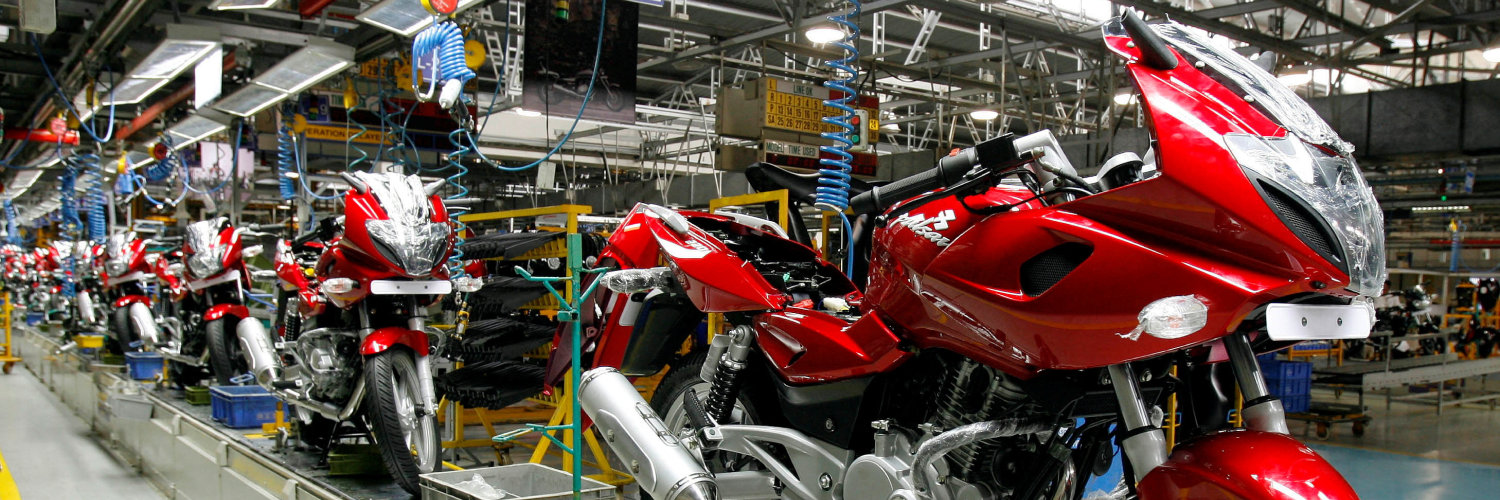
Bajaj Auto Ltd
Glance View
Bajaj Auto Ltd., a pillar in the automotive industry, traces its roots back to the pre-independence era of India, evolving dynamically through decades of economic transitions. Initially part of the diversified Bajaj Group, which dabbled in sectors from home appliances to steel, Bajaj Auto set its course towards defining the very landscape of personal mobility in India. It rose to prominence as the manufacturer of the iconic Chetak scooter, becoming a household name synonymous with two-wheelers in the country. In a keenly competitive market, Bajaj Auto emerged not merely as a player but a trendsetter, laying the groundwork for India's burgeoning two-wheeler industry by focusing on affordability, durability, and accessibility for the masses. Bajaj Auto thrives on its strategic embracing of innovation and adaptability, seamlessly pivoting from scooters to motorcycles as market preferences shifted. This transformation was bolstered by its swift adoption of technologically advanced practices and global partnerships, notably its alliances with brands like KTM and its acquisition of a significant stake in the British motorcycle brand Triumph. These efforts propelled it beyond Indian borders, scaling its reach to over 70 countries, effectively making it the world's third-largest manufacturer of motorcycles and the largest producer of three-wheelers. The company's diversified revenue streams—from commuter motorcycles catering to urban and rural areas, premium offerings to tap into lifestyle trends, and robust three-wheeler segments serving both passenger and cargo needs—demonstrate its adeptness at fostering both domestic dominance and international expansion. Through strategic manufacturing efficiencies and lean cost structures, Bajaj Auto continues to drive financial performance with innovation and global reach acting as its twin engines.
