
Lucid Group Inc
F:CH2



Decide at what price you'd be comfortable buying and we'll help you stay ready.

|
Lucid Group Inc
F:CH2
|
US |
|
T
|
Tsingtao Brewery Co Ltd
SWB:TSI
|
CN |
|
L
|
Lloyds Banking Group PLC
NYSE:LYG
|
UK |
Lucid Group Inc
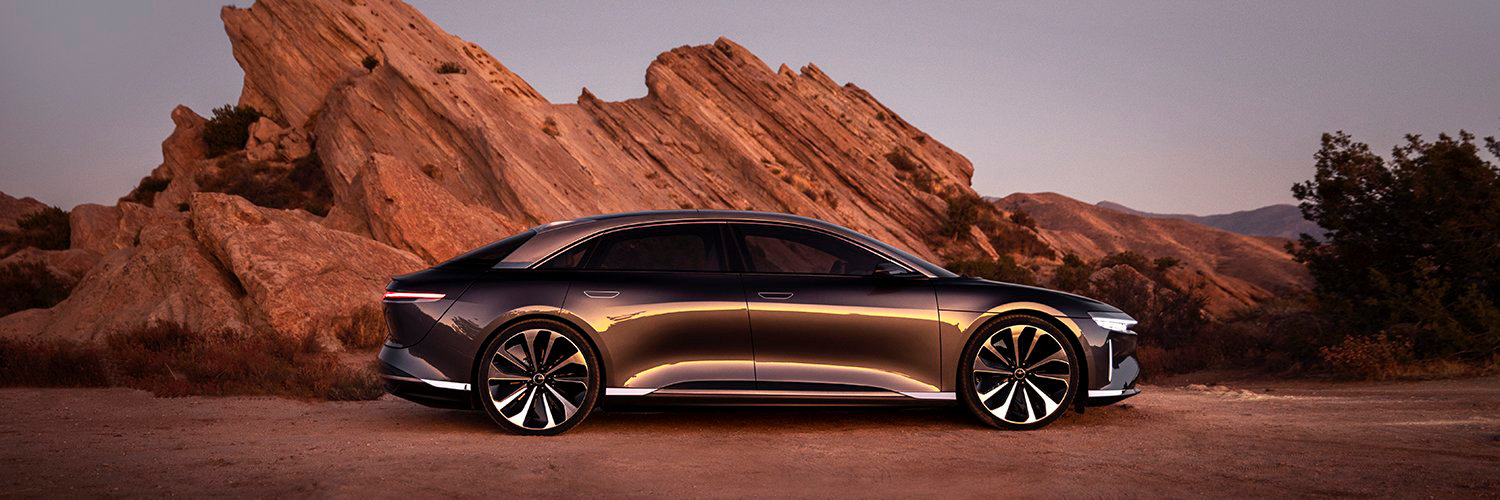
Lucid Group designs and builds luxury electric vehicles, starting with the Lucid Air sedan and moving into other EV models. It also sells related software, powertrain, and battery technology that help its cars go farther on a charge and perform like premium vehicles. Its main customers are affluent car buyers, especially in the U.S. and other markets where high-end electric cars are sold. Lucid makes money mainly by selling vehicles, along with options, upgrades, parts, service, and charging-related offerings tied to those cars. It also has a role as a technology company because much of the value in its business comes from its in-house battery systems, electric drivetrains, and vehicle software rather than from buying generic components off the shelf. That makes Lucid more than just an automaker: it is trying to control the core engineering behind its cars. The company sits in the premium EV segment, where buyers care about range, performance, design, and brand image. Its business model depends on selling high-spec vehicles directly to customers and building a reputation for advanced electric-vehicle engineering. Compared with traditional carmakers, Lucid is focused on a narrower, more upscale slice of the market and tries to stand out through its own battery and drivetrain technology.
Lucid Group designs and builds luxury electric vehicles, starting with the Lucid Air sedan and moving into other EV models. It also sells related software, powertrain, and battery technology that help its cars go farther on a charge and perform like premium vehicles. Its main customers are affluent car buyers, especially in the U.S. and other markets where high-end electric cars are sold.
Lucid makes money mainly by selling vehicles, along with options, upgrades, parts, service, and charging-related offerings tied to those cars. It also has a role as a technology company because much of the value in its business comes from its in-house battery systems, electric drivetrains, and vehicle software rather than from buying generic components off the shelf. That makes Lucid more than just an automaker: it is trying to control the core engineering behind its cars.
The company sits in the premium EV segment, where buyers care about range, performance, design, and brand image. Its business model depends on selling high-spec vehicles directly to customers and building a reputation for advanced electric-vehicle engineering. Compared with traditional carmakers, Lucid is focused on a narrower, more upscale slice of the market and tries to stand out through its own battery and drivetrain technology.
Reset underway: New CEO Silvio Napoli said Lucid needs a major operational reset, citing missed commitments, weak execution, quality problems, and a need to rebuild trust with customers, employees, suppliers, and investors.
Cost cuts: Management identified about $1.4 billion of cash flow improvement for 2026 and said the company already cut 20% of its U.S. workforce and eliminated a second shift in Arizona, creating $158 million of projected annualized savings.
Demand vs. production: Lucid deliberately reduced production to 4,774 vehicles in Q2 to align output with demand and reduce inventory, while deliveries rose to 3,953 vehicles.
Liquidity: The company said it had $3 billion of total liquidity at June 30, then drew an additional $800 million after quarter end, and now expects liquidity to extend well into 2027.
Guidance caution: Lucid did not give formal financial guidance, but management said Q3 and Q4 production should be below Q2 levels, while second-half deliveries should improve seasonally and be above production as inventory is worked down.
Strategic bets: Lucid highlighted three major growth pillars: the Uber/Nuro robotaxi program, AMP-2 in Saudi Arabia, and the mid-size platform, while also saying licensing and other technology opportunities are being explored.
Quality focus: Management said software quality improved during the quarter and service capacity is being expanded, with technicians and dedicated service staff set to rise 35% and mobile service capacity more than 20% by year-end.